Cat wound care is one of the most important skills any cat owner can develop — and one that most people are completely unprepared for until they need it. Cats are curious, territorial, and often outdoor animals that regularly encounter hazards: fights with other cats, encounters with wildlife, sharp objects, and falls. When an injury happens, knowing how to assess it, clean it properly, and decide whether it needs veterinary attention can make the difference between a straightforward recovery and a serious, life-threatening infection. This guide covers everything you need to know about cat wound care — types of wounds, step-by-step home treatment, when to go to the vet, and the natural supplements that support healing from the inside.
Types of Cat Wounds
Not all cat wounds are the same — and the type of wound determines the correct treatment approach. Understanding what you’re dealing with before you act is the first step in effective cat wound care.
The most common cat wound — usually from fights with other cats. Deceptively dangerous because the entry point is tiny but the bacteria-laden puncture goes deep into tissue. Cat bite wounds abscess rapidly — often within 24–48 hours. Always require veterinary attention even when they appear minor on the surface.
Open cuts from sharp objects — glass, metal, wire fencing. Can range from superficial scratches to deep wounds requiring stitches. Bleeding is usually visible. Lacerations longer than 1cm or gaping open generally require veterinary closure to heal properly and prevent infection.
Surface grazes that remove the top layer of skin without penetrating deeply — often from road accidents or rough surfaces. Usually bleed minimally but are painful and prone to contamination with dirt and debris. Most can be managed at home with thorough cleaning if superficial.
Small entry points from thorns, wire, or teeth that penetrate deep into tissue. The deceptive nature of puncture wounds — a small surface opening concealing significant internal damage — makes them particularly dangerous. Deep punctures near joints, the chest, or abdomen require immediate veterinary care.
From hot surfaces, chemicals, or electrical sources. Chemical burns in particular may not be immediately apparent — the cat may have walked through a substance and self-groomed, causing internal and external damage simultaneously. All significant burns require emergency veterinary treatment.
From road accidents, falling objects, or being caught in machinery. The external wound may appear minor while significant internal damage has occurred to organs, bones, and blood vessels. Any suspected crush injury — particularly from a road accident — requires immediate emergency veterinary assessment regardless of how the cat appears externally.
The most important rule in cat wound care: When in doubt, go to the vet. Cats hide pain exceptionally well — a cat that appears calm may have a serious wound. It is always better to have a wound assessed and be told it is minor than to manage a serious injury at home.
When to Go to the Vet Immediately
Certain wounds require emergency veterinary care — no home treatment, no waiting to see how it develops. These situations are non-negotiable:
- Bleeding that doesn’t stop within 5 minutes
- Deep puncture wounds anywhere on the body
- Any wound near the eyes, chest, or abdomen
- Suspected bite wounds — even small ones
- Road accident injuries — always
- Wounds with exposed tissue, fat, or bone
- Burns of any significant size
- Signs of shock — pale gums, rapid breathing, collapse
- Wounds that smell bad or have discharge
- A cat that won’t bear weight after an injury
Bite wounds from other cats deserve particular emphasis. What appears to be a tiny puncture on the surface — often just two small holes from canine teeth — can introduce significant bacterial contamination deep into tissue. Cat saliva contains bacteria including Pasteurella multocida that cause rapid, aggressive infection. A cat bite wound that looks minor today can be a life-threatening abscess by tomorrow. Always have bite wounds assessed by a vet within 24 hours.
Cat Wound Care at Home — Step by Step
For minor wounds — small superficial cuts, minor abrasions, or small grazes — appropriate home care can prevent infection and support healing. Here is the correct procedure:
Before You Start — Safety First
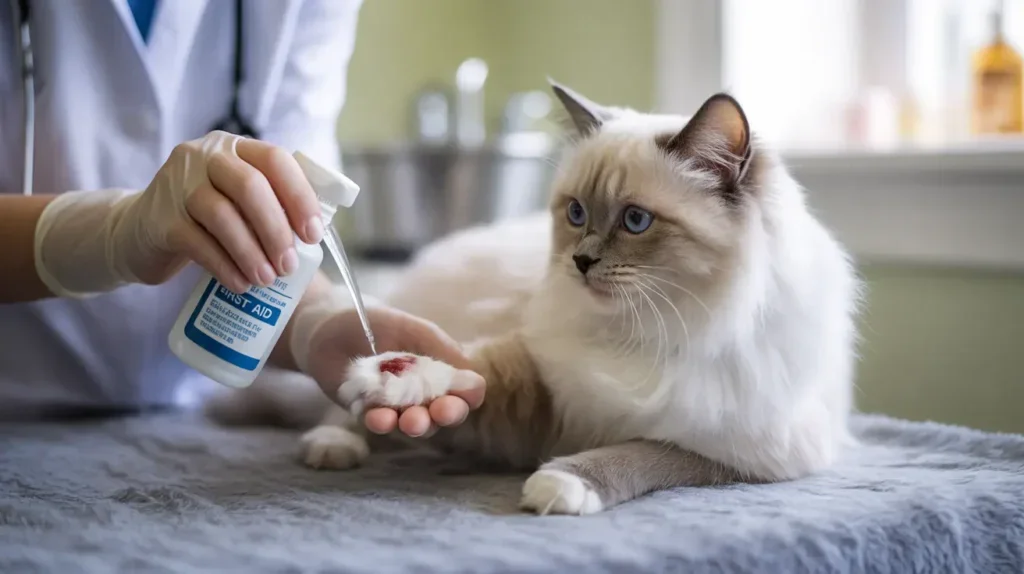
A cat in pain is a cat that may bite or scratch — even the most gentle cat. Before attempting to clean any wound, wrap your cat securely in a large towel with only the affected area exposed. This protects you and prevents the cat from making the wound worse by struggling. Have all your supplies ready before you begin so the process is as quick and calm as possible.
- Control any bleeding first. Apply gentle, firm pressure to the wound using a clean cloth or sterile gauze for 3–5 minutes without lifting to check. Do not use cotton wool directly on the wound — fibres stick to the wound surface. If bleeding is heavy or does not stop, go to the vet immediately.
- Clip the fur around the wound. Using blunt-tipped scissors, carefully trim the fur away from the wound edges. This prevents contamination, allows you to see the wound clearly, and makes cleaning and bandaging significantly easier. Apply a small amount of water-based lubricant to the wound first to catch clipped fur and prevent it from entering the wound.
- Flush the wound thoroughly with saline. Use sterile saline solution (0.9% sodium chloride) or cooled boiled water to gently but thoroughly flush the wound. Use a syringe or clean bottle to create gentle pressure. The goal is to remove all visible dirt, debris, and bacteria from the wound surface. This is the most important step in preventing infection.
- Clean the surrounding skin. Using diluted chlorhexidine solution (available from vets and pharmacies) on a clean gauze pad, gently clean the skin around the wound — working from the wound outward. Never use hydrogen peroxide, iodine, or alcohol directly on wounds — all three damage tissue and delay healing.
- Apply a cat-safe antiseptic. A small amount of veterinary-approved antiseptic gel or cream can be applied to the wound surface to reduce bacterial contamination. Never use human antiseptics like Savlon, TCP, or Dettol — these contain compounds toxic to cats.
- Cover if necessary. For larger abrasions, a light non-stick dressing held with veterinary cohesive bandage can protect the wound. Change daily. For small wounds, leaving uncovered and allowing air circulation is often preferable. Monitor closely for signs of infection.
- Prevent licking. Cats instinctively lick wounds — and while cat saliva has some mild antibacterial properties, excessive licking introduces more bacteria, removes healing tissue, and can cause the wound to reopen. An Elizabethan collar (cone) or medical pet shirt is essential for any wound your cat can reach.
What NOT to use on cat wounds: Never apply hydrogen peroxide, TCP, Dettol, Savlon, tea tree oil, iodine, or any human antiseptic to a cat’s wound. Many of these are directly toxic to cats — particularly tea tree oil, which can cause neurological symptoms even in small topical doses. Sterile saline and veterinary-approved chlorhexidine are the only safe cleaning agents.
Support your cat’s wound healing naturally
Browse our range of natural recovery and immune support supplements for cats at MyHealthyPet.
Recognising Wound Infection in Cats
Even well-cleaned wounds can become infected — particularly bite wounds and punctures. Knowing the signs of infection means you can act before it becomes serious. Check the wound at least twice daily during healing.
- Increasing redness around the wound
- Swelling that grows rather than reduces
- Warmth around the wound site
- Discharge — yellow, green, or brown
- Unpleasant or sweet odour from the wound
- The wound reopening or edges separating
- Your cat becoming lethargic or feverish
- Loss of appetite following an injury
- A soft, fluctuating swelling (abscess forming)
- Excessive licking or attention to the wound area
A forming abscess — a pocket of pus that develops most commonly after bite wounds — appears as a soft, warm, fluctuating swelling under the skin. The overlying skin may look normal or slightly discoloured. Abscesses are extremely painful and require veterinary treatment — they need to be lanced, flushed, and treated with antibiotics. Never attempt to drain an abscess at home.
Fever in cats: A cat’s normal temperature is 38–39.2°C. A cat with a wound infection may develop a fever — signs include lethargy, loss of appetite, shivering, and a warm, dry nose. If you suspect your cat has a fever alongside a wound, see a vet the same day.
Cat Bite Abscesses — What to Expect
Because bite wound abscesses are so common in cats — particularly outdoor cats — it’s worth understanding the full progression so you know what to expect and what to do at each stage.
| Timeline | What’s Happening | Action Required |
|---|---|---|
| Day 0–1 | Bite occurs. Small puncture wounds may be barely visible. Cat may seem fine. | ~ See vet within 24hrs |
| Day 1–3 | Bacteria multiplying under skin. Swelling begins. Cat may become quieter and less active. | ✗ Vet urgently |
| Day 3–5 | Abscess fully formed — soft, painful swelling. Cat likely feverish and not eating. | ✗ Emergency vet |
| Day 5–7 | Abscess may rupture spontaneously — foul-smelling discharge. Temporary relief for cat but still needs treatment. | ✗ Vet same day |
| Post-treatment | Vet flushes wound, prescribes antibiotics. Recovery typically 7–14 days with proper care. | ✓ Home care + supplements |
Natural Supplements That Support Cat Wound Recovery
Once a wound has been properly treated — either at home for minor injuries or by a vet for more serious ones — the right supplements can meaningfully support healing, reduce inflammation, and strengthen the immune response that fights residual infection. These are the supplements with the strongest evidence for supporting recovery in cats.
EPA and DHA from fish oil reduce the inflammatory response at wound sites — decreasing swelling, redness, and pain while supporting the resolution phase of healing. Omega-3s also support skin cell regeneration and the formation of new tissue. For cats recovering from wounds or abscesses, fish oil supplementation accelerates the transition from inflammation to repair. Cat-specific marine-source omega-3s are essential — cats cannot convert plant-based ALA.
Shop Omega-3 →Essential for collagen synthesis — the structural protein that forms the framework of healing skin, connective tissue, and wound closure. Cats produce their own vitamin C but production drops significantly during illness, stress, and injury — precisely when demand is highest. Vitamin C supplementation during wound recovery supports faster, stronger tissue repair and enhances immune function simultaneously.
Shop Vitamin C →One of the most important minerals for wound healing — zinc is involved in every phase of the repair process: inflammation control, new cell production, and collagen formation. Zinc deficiency directly impairs wound healing and increases infection susceptibility. Supplementation during recovery supports faster closure and reduces the risk of the wound reopening or becoming infected. Use cat-safe doses — excessive zinc is toxic to cats.
Shop Zinc →Particularly important for cats recovering from wounds that required antibiotic treatment. Antibiotics disrupt the gut microbiome — reducing the diversity of beneficial bacteria that regulate immune function. A cat-specific probiotic restores microbial balance, supports the immune response needed to prevent secondary infection, and reduces the digestive side effects — vomiting and diarrhoea — that frequently accompany antibiotic courses in cats.
Shop Probiotics →Curcumin’s anti-inflammatory properties make it a useful natural support during the early inflammatory phase of wound healing. It inhibits the inflammatory cytokines that cause excessive swelling and tissue damage while allowing the necessary immune response to proceed. For cats sensitive to NSAIDs or those on long-term wound management, turmeric provides a gentler anti-inflammatory option. Must be cat-safe dosed — consult your vet before use.
Shop Turmeric →A fat-soluble antioxidant that protects newly forming skin cells and scar tissue from oxidative damage during the repair process. Vitamin E supports the integrity of cell membranes in healing tissue and has been shown to reduce scar formation when levels are adequate during recovery. Works synergistically with omega-3 fatty acids for comprehensive skin and tissue repair support.
Shop Vitamin E →Preventing Cat Wounds — Practical Steps
The best cat wound care is preventing wounds from happening in the first place. Many of the most common feline injuries are entirely preventable with a few straightforward measures.
- Neuter your cat — Unneutered cats — particularly males — roam significantly further and fight far more frequently than neutered cats. Neutering is the single most effective measure for reducing bite wound injuries in outdoor cats.
- Supervise outdoor access — Dawn and dusk are peak times for cat territory disputes and wildlife encounters. Keeping your cat in during these hours significantly reduces injury risk.
- Check fencing and garden hazards — Inspect garden fencing for sharp wire ends, broken glass, or protruding nails. Cats that jump fence lines regularly are at risk from these hazards.
- Keep vaccinations up to date — Feline leukaemia virus (FeLV) and feline immunodeficiency virus (FIV) are both transmitted through bite wounds. Keeping your cat vaccinated against FeLV significantly reduces the consequences of outdoor cat fights.
- Consider a secure garden enclosure — A catio or secure garden run provides outdoor enrichment while eliminating exposure to other cats, traffic, and wildlife — removing the majority of wound risk entirely for high-risk cats.
- Keep your cat indoors at night — The majority of serious cat fights and road accidents occur after dark. An indoor-at-night policy dramatically reduces injury risk for outdoor cats.
Support your cat’s immune health year-round
A strong immune system heals faster. Browse our natural cat health supplements at MyHealthyPet.
Cat First Aid Kit — What Every Owner Should Have
Having the right supplies ready before an injury occurs means you can act immediately and calmly rather than searching for items while your cat is distressed. Keep these items in a clearly labelled box at home:
- Sterile saline solution (0.9% sodium chloride) for wound flushing
- Diluted chlorhexidine solution for wound cleaning
- Sterile gauze pads and non-stick dressings
- Veterinary cohesive bandage (self-adhesive, does not stick to fur)
- Blunt-tipped scissors for trimming fur around wounds
- Disposable gloves — always wear when treating wounds
- A large towel for wrapping and restraining your cat safely
- Digital rectal thermometer to check for fever
- Elizabethan collar (cone) to prevent licking
- Your vet’s phone number and the nearest 24-hour emergency vet number
Never include in your cat first aid kit: Hydrogen peroxide, TCP, Dettol, Savlon, iodine, tea tree oil, aspirin, ibuprofen, paracetamol, or any human medication. Paracetamol is fatal to cats — even a single tablet. Keep all human medications completely out of reach and never administer them to a cat under any circumstances.
The Bottom Line
Cat wound care is a skill that every owner should have — because injuries happen, and how quickly and correctly you respond makes a real difference to outcomes. The fundamentals are straightforward: assess the wound carefully, clean it properly with the right products, protect it from licking, monitor closely for infection, and never hesitate to call the vet when in doubt.
For more serious wounds — particularly bite wounds, deep punctures, and any injury involving significant bleeding or internal risk — veterinary care is not optional. Once your cat is on the road to recovery, the right nutritional support can meaningfully accelerate healing, reduce inflammation, and rebuild the immune resilience that protects against future infections.
At MyHealthyPet, we stock only natural, quality products chosen because we’d trust them with our own animals. Browse our cat health supplement range or contact us if you need help finding the right products for your cat’s recovery — we’re always happy to help.